Note: This article was written by Rick LeBlanc and originally published in the June 2026 issue of Pallet Enterprise magazine. It is republished here with permission.
The origin story behind Litco International’s custom crating division is straightforward. A customer had a problem and needed help.
“It all started from a customer who had an issue and needed someone to supply a solution,” said Ben Timmons, vice president of sales, who joined Litco more than two years ago after prior roles with sister company Millwood and elsewhere in the packaging industry. “And we were able to come up with a solution that worked for them.”
That initial project, built around a single SKU for an HVAC manufacturer, has since developed into a growing business unit. What began in a small area of Litco’s Warren, Ohio, load securement division has expanded through a series of moves, each one driven less by long-term planning than by the steady accumulation of customer demand.
Expanding with the Market
Today, Litco is relocating its crating division into a 44,000-square-foot facility in Lordstown, Ohio. The move reflects both growth and geography.
From its Midwest base, Litco provides custom crating to a regional manufacturing corridor that includes Ohio, western Pennsylvania and surrounding states. Through its relationship with Millwood, the company can also support customers nationally, particularly those requiring coordinated packaging solutions across multiple locations. That positioning has helped fuel the crating division’s expansion. As customer volumes increased, so did the need for space, material flow and inventory capacity.
“We thought when we moved into this previous facility, we got all this room. This is great,” Timmons recalled. That feeling of having elbow room did not last long. “And then after about a year, we’re getting tight.”
The new facility offers additional square footage for production, storage and offices. It also allows Litco to bring in larger volumes of raw material, improve layout and support a more consistent production flow.
A Different Kind of Operation
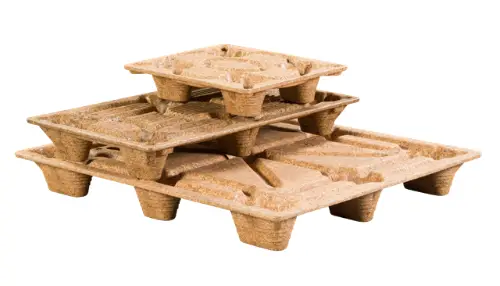
Custom crating operates differently from the high-speed production of Litco’s Engineered Molded Wood™ (presswood) pallets. It requires a more deliberate pace and a different set of skills.
“It takes a different mindset from the employee to be able to look at something and say, ‘All right, how am I going to solve this problem?’” Timmons said.
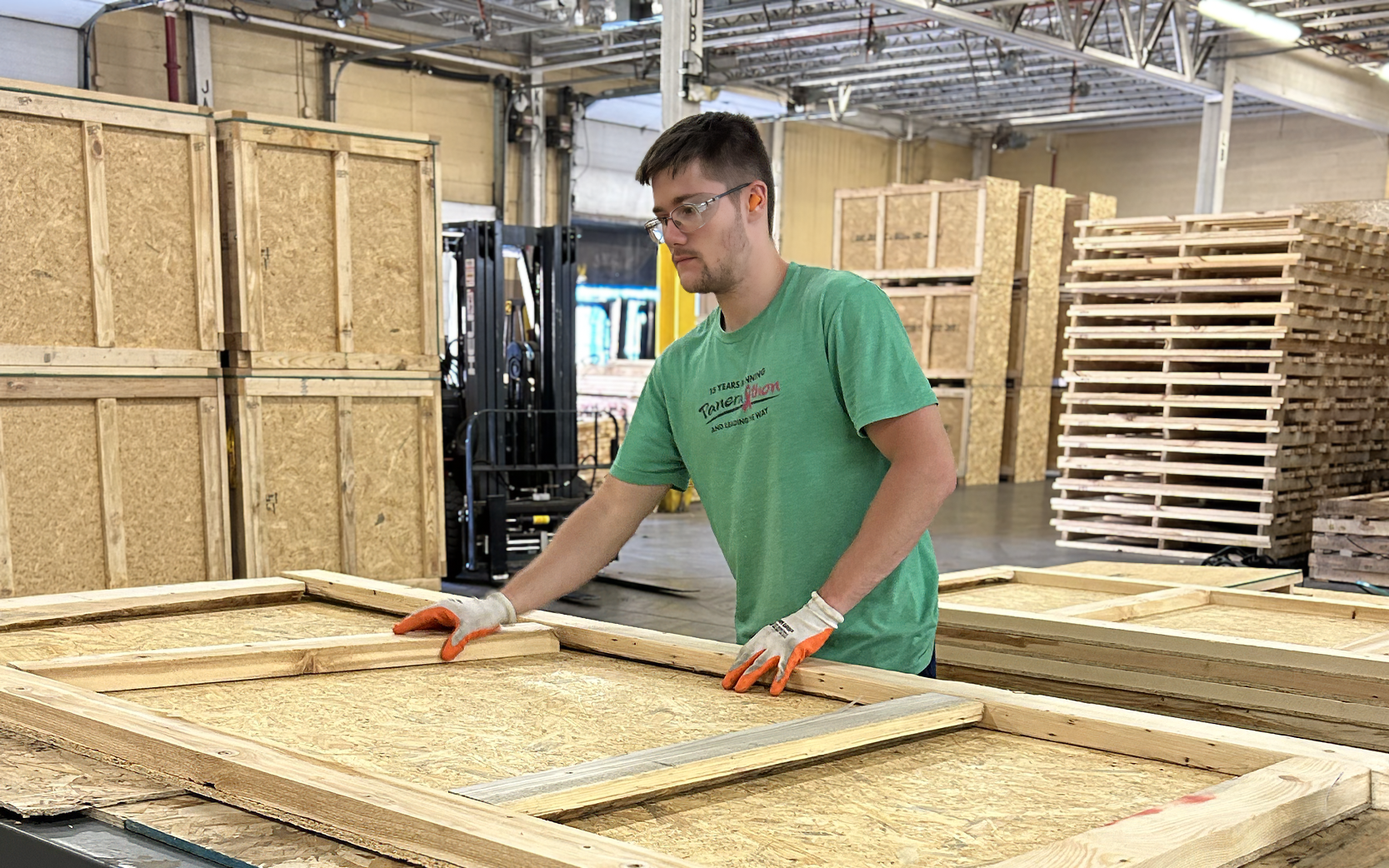
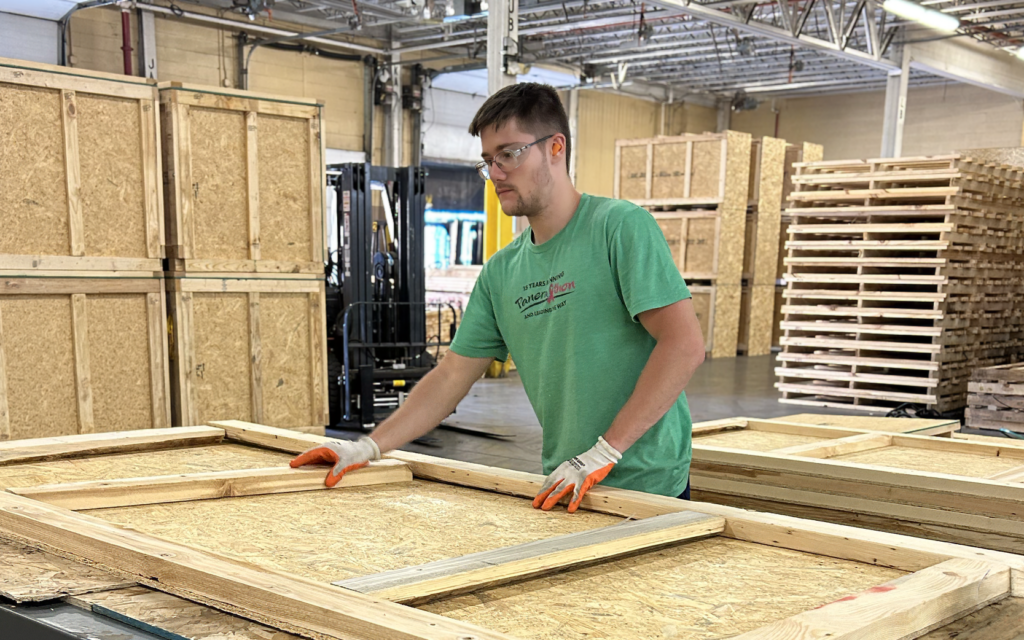
Litco’s early hires reflected that need. The company brought in individuals with carpentry backgrounds who could interpret drawings, work through complex builds, and adapt as requirements changed. That foundation remains in place today under the leadership of Jeff Bowser, the custom crating operations manager.
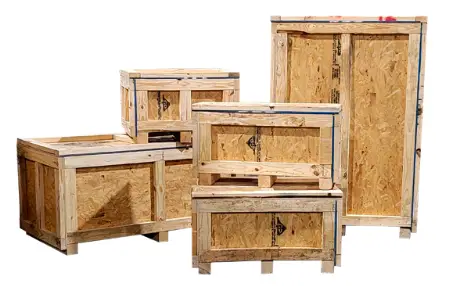
The range of work varies widely. Some crates measure more than 60 feet in length, while others are compact, highly specialized builds. Each project begins with understanding the product being shipped and working backward to determine the most effective design.
That front-end work has become increasingly collaborative. Rather than handing off jobs after the sale, Litco’s operations team is often involved early, sometimes joining customer visits to understand the product and constraints firsthand.
“We’ll go with sales to the customer, and they’ll say, ‘here’s the product, here’s what we’re trying to ship,’” Timmons said. “Then we can come up with how to build a crate and the most efficient way to do it.”
From there, the focus shifts to consistency. Each design needs to translate cleanly to the shop floor. “We want to be able to take that to a customer and say ‘this is how we drew it, this is how we understand it, and please sign off,’” Timmons said. “Then we can hand it to the employee with a cut list and assembly instructions, and they can follow it like a recipe.”
Behind the scenes, the sales and production process is supported by Litco’s Epicor ERP system, which ties together customer orders, production scheduling and invoicing. Customer purchase orders are entered into the system, reviewed for accuracy, and then passed to the operations team as a working queue. From there, production tracks time, labor and material usage before the job cycles back to headquarters for billing once the product ships.
Built Around Customer Timing
As the operation has grown, timing has become just as important as design.
One of the value-added characteristics of Litco’s crating model is coordinating it with customer production schedules.
“We’re almost like a JIT shop, where they give us basically a 90-day forecast,” Timmons noted. Based on that forecast, Litco will build inventory. “Then they let us know on a shorter timetable,” he said. “‘Hey, I need 10 of these, four of these and three of these.’” That approach allows Litco to build inventory in advance while maintaining flexibility for changing demand. But it also puts pressure on space and organization as volumes increase. The move to the new Lordstown facility is intended to ease those constraints while supporting continued growth.
In some cases, that coordination extends directly into the customer’s production process. For one customer, crating is not handled at a separate packing station. Instead, it is built directly into the production flow. That setup improves efficiency but leaves little room for delay or disruption.
“With that particular customer, the crating really became part of the production line,” explained John Weisman, Litco’s marketing communications manager since 2021. “Parts were coming right off the assembly line, and they had to go right into the crates.” After the customer experienced supply issues and resulting production bottlenecks due to supply issues with other vendors, Litco stepped in to fill the gap. “We just rolled up our sleeves and really came alongside,” Weisman said.
Weisman brings a communications and design background to his role, along with earlier experience in ministry, something that aligns with the company’s emphasis on Christian values, relationships and long-term trust.
Equipment Upgrades to Play a Role Going Forward
While the crating division is less equipment-intensive than molded wood pallet production, process improvements remain a focus. The operation currently relies predominantly on chop saws, panel saws for cutting lumber and sheet materials, and fastening hand tools. As volumes grow, Litco is evaluating additional equipment to improve throughput and reduce reliance on pre-cut materials.
Design work is handled through CAD software, allowing the team to generate drawings, cut lists, and repeatable builds. Customers often provide initial specifications, which Litco then refines or adapts as needed.
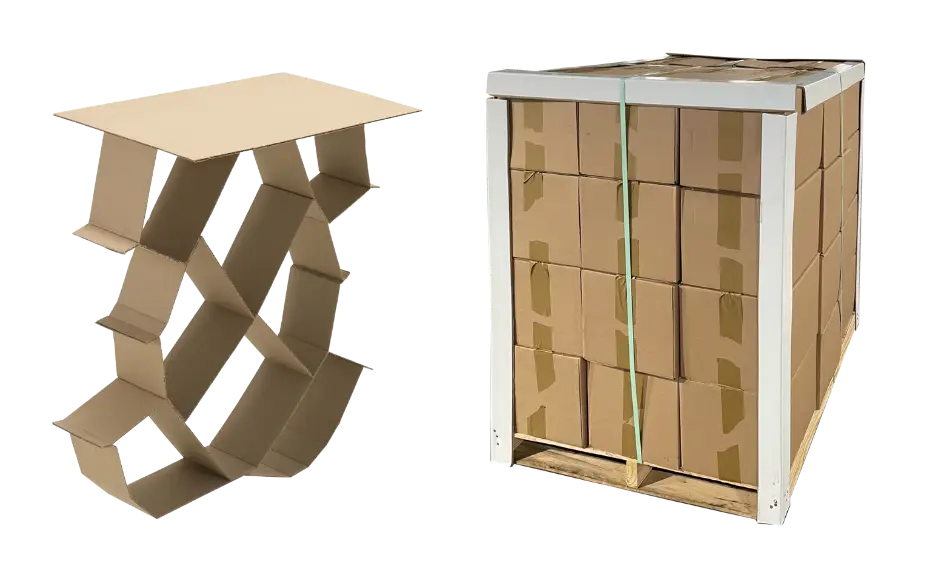
Founded in 1962, the company is known for its molded wood pallets, including nestable designs with Cradle to Cradle certification and USDA BioPreferred designation. In addition to pallets, Litco produces core plugs and other molded fiber components. The recent introduction of a bottom-deck pallet option expands its reach into applications requiring load stacking, conveyability or compatibility with automated systems. The company also has a dedicated load containment solutions division.
The move to Lordstown gives Litco more room to work with: more space for raw materials, more capacity for finished inventory, and a layout that better supports the flow of work through the plant.
How long that space lasts is another question. “We hope it gives us some room for a period of time,” Timmons said. “But also, I hope we outgrow it pretty quickly, too.”
For now, the focus is on keeping up with the work in front of them, building ahead where it makes sense, responding quickly when it matters, and continuing to take on projects that don’t always come with a clear starting point. “We don’t want to say ‘no’ to a customer if they’re bringing us an opportunity,” Timmons acknowledged. “We want to figure out how we can help them out.”