ARTICLE
The Science of Durable Pallets: 5 Ways Pressed Wood Pallets Outperform Conventional Stringer Pallets
The Science of Durable Pallets: 5 Ways Pressed Wood Pallets Outperform Conventional Stringer Pallets
Table of Contents
“Engineered through science and precision molding, Litco pressed wood pallets deliver superior performance validated by rigorous testing.”
Read a Case Study
Wonderful® Pistachios, America’s top-selling snack nut, was experiencing shipping damage to its seasonal point-of-purchase (POP) displays. The primary cause: unreliable recycled wooden stringer pallets.
“Each pallet is molded under intense heat and pressure, bonding recycled wood fibers into a dense, uniform structure. No nails, no boards, no weak spots – just pure engineered strength that stands the test of time.”
“The science behind pressed wood pallets goes beyond material strength – it’s about total system efficiency and supply chain resilience. From warehouse storage to last-mile delivery, every design element has been optimized for performance and profitability.”
April 16, 2026
9 Minute Read
Wooden pallets have been the backbone of global trade and logistics for nearly a century. Over that time, they’ve sustained wartime supply lines, transported products across continents, and anchored retail and point of purchase displays (POP displays) in stores worldwide. Yet like every essential tool in the supply chain, pallets have continued to evolve to meet new demands.
Today’s supply chain leaders can no longer afford to overlook this critical tool. As Glenn Meeks of Bettaway Transportation Logistics and Pallet System puts it:
“Pallets are the cells of the supply chain.”
If that’s true, then the pallet may be the smallest yet most vital link in your logistics system. Still, many treat it as an afterthought. John Vaccaro, quoted in the American Journal of Transportation, describes the problem this way:
“Pallets for years have been a somewhat underappreciated, if not disrespected, segment of the supply chain, considered an operating cost and not a valued asset. Yet nothing could be more important to the shipping of goods.”
It’s time to reframe how supply chain managers, warehouse operators, and packaging engineers view pallets. This article explores why durable pallets – particularly pressed wood pallets – outperform traditional GMA-style wooden pallets, as evidenced by industry-leading research and real-world durability testing.
The Science Behind a Better Pallet
1. Engineered Strength That Carries the Load – and Then Some
In every warehouse and distribution center, pallets are the backbone of logistics. Yet few decision-makers realize how much performance, safety, and cost depend on choosing the right pallet. Inferior pallets bend, crack, or collapse – causing product damage, safety risks, and expensive supply chain inefficiencies.
That’s why Litco developed a smarter, stronger, and more sustainable solution: pressed wood pallets. Engineered through science and precision molding, they deliver superior performance validated by rigorous pallet durability analysis.
According to the whitepaper Comparison of Pallet Strength and Functionality by Dr. Marshall S. White, Litco pallets outperform traditional GMA-style wooden pallets – new or repaired – across every critical metric. They’re stronger, stiffer, cleaner, and more consistent, giving companies a competitive edge from production line to point of sale.
Here are five scientific reasons Litco’s pressed wood pallets deliver superior performance.
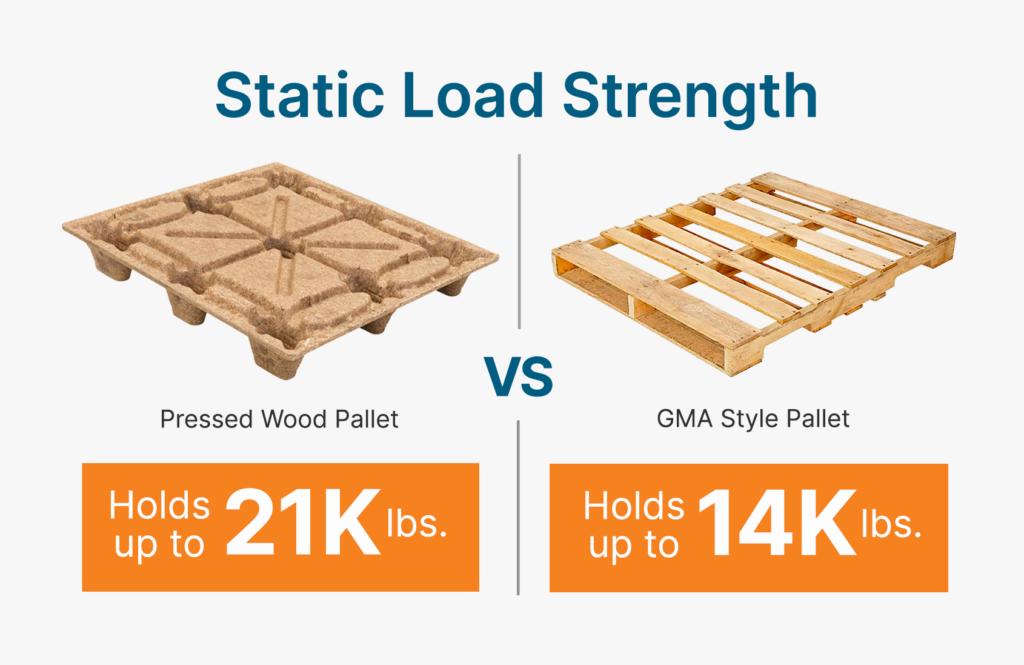
When you evaluate pressed wood pallets scientifically, one number stands out: static load capacity. In laboratory testing, Litco’s heavy-duty pressed wood pallets achieved 16,000 – 21,500 lb of static strength, while comparable GMA pallets topped out at 14,000 lb. That’s up to 70 percent more strength – a game-changing margin for heavy or high-value loads.
Why it matters:
- Fewer load failures when stacking or storing.
- Reduced product damage from bending or collapse.
- Extra safety margin for uneven flooring, forklift impacts, or overweight scenarios.
- Confidence when shipping delicate items, including POP displays and point of purchase displays that must arrive in pristine condition.
Each pallet is molded under intense heat and pressure, bonding recycled wood fibers into a dense, uniform structure. No nails, no boards, no weak spots – just pure engineered strength that stands the test of time.
This is why businesses looking to choose the right pallet for demanding applications consistently pick pressed wood pallets. They’re not just strong – they’re scientifically proven.
2. Stiffness That Protects Every Product
Strength matters, but stiffness is the secret weapon behind product safety and pallet longevity.
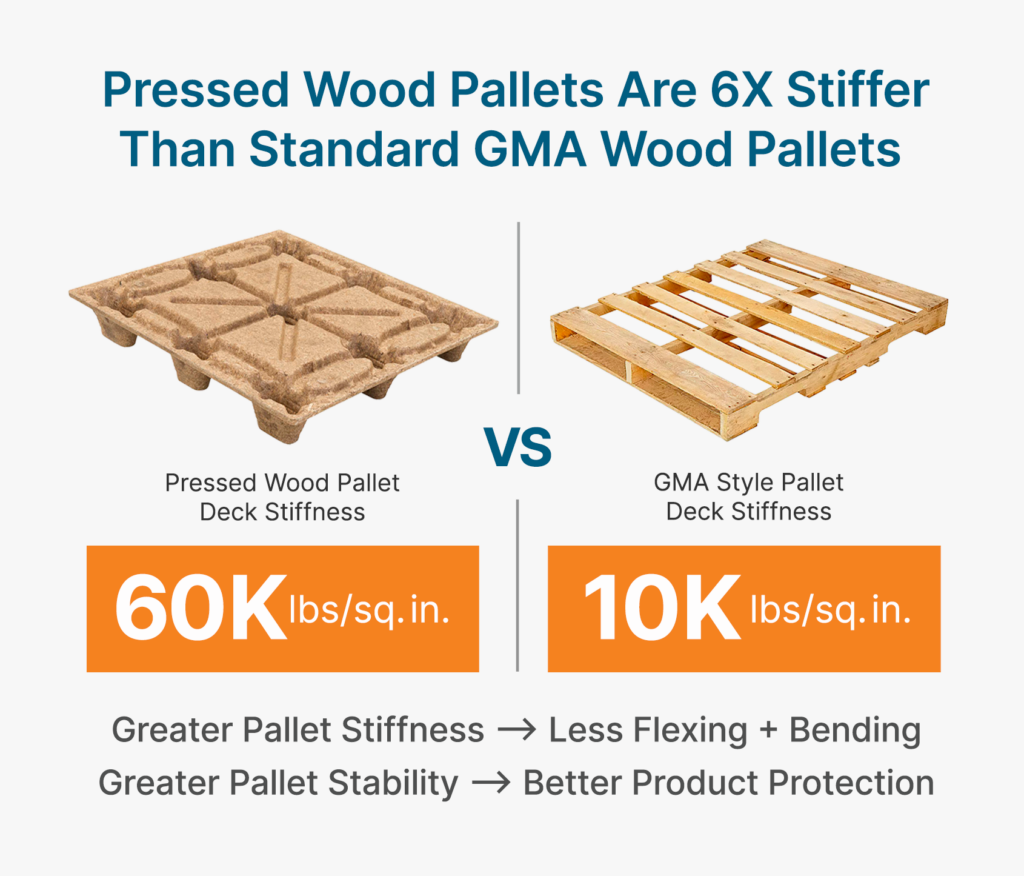
In controlled testing, pressed wood pallets demonstrated six times more deck stiffness than standard wooden pallets – 60,000–86,000 lb/in vs. 10,000–11,000 lb/in. That translates to less bending, better stability, and reduced product damage during handling or transit.
For operations that demand reliability, this level of rigidity is one reason pressed wood designs are increasingly recognized as durable pallets built for modern logistics environments.
Stiffer pallets mean:
- Smoother forklift handling: no flexing, even under heavy loads.
- Reduced vibration: fewer micro-movements that wear out packaging or loosen loads.
- Optimized for automation: uniform decks improve the efficiency of conveyors, palletizers, and stretch wrappers.
- Protection for high-value retail goods: from electronics to POP displays, everything rides safer and arrives showroom-ready.
This pallet durability analysis confirms what packaging engineers already know: deck stiffness directly correlates to reduced product loss.
The molded rib structure ensures every unit is identical – no warped boards or inconsistent thicknesses that plague traditional wood. That consistency builds trust in automated environments, where even small variations can shut down a line.
For additional research on stiffness and load-bearing dynamics, see the Virginia Tech Center for Packaging and Unit Load Design (CPULD) – a leading authority on pallet performance and testing methods.
3. Impact Resistance That Outlasts Rough Handling
Forklifts aren’t gentle. Every day, pallets endure scraping, dropping, and edge impacts that can quickly destroy ordinary wood designs. That’s why impact resistance is a critical metric in any pallet durability analysis.
The whitepaper’s findings are clear: pressed wood pallets withstand 8,500 ft-lb of fork-tine impact before failure, compared to 5,600 ft-lb for GMA pallets. That’s over 50 percent better performance under the same rough treatment.
Here’s what that means in real operations:
- Fewer cracked boards or splinters;
- Less downtime caused by pallet failure;
- Longer life cycle and fewer replacements; and
- Safer handling overall for warehouse employees.
Because pressed wood pallets are molded as a single, solid piece, there are no fasteners or weak joints to loosen over time. The high-density fiber matrix distributes shock evenly throughout the structure, giving these durable pallets exceptional resilience.
To learn more about the standard pallet testing procedures this research is based on, check out ASTM D1185 – Standard Test Methods for Pallets and Related Structures, which defines impact and load testing protocols used across the industry.
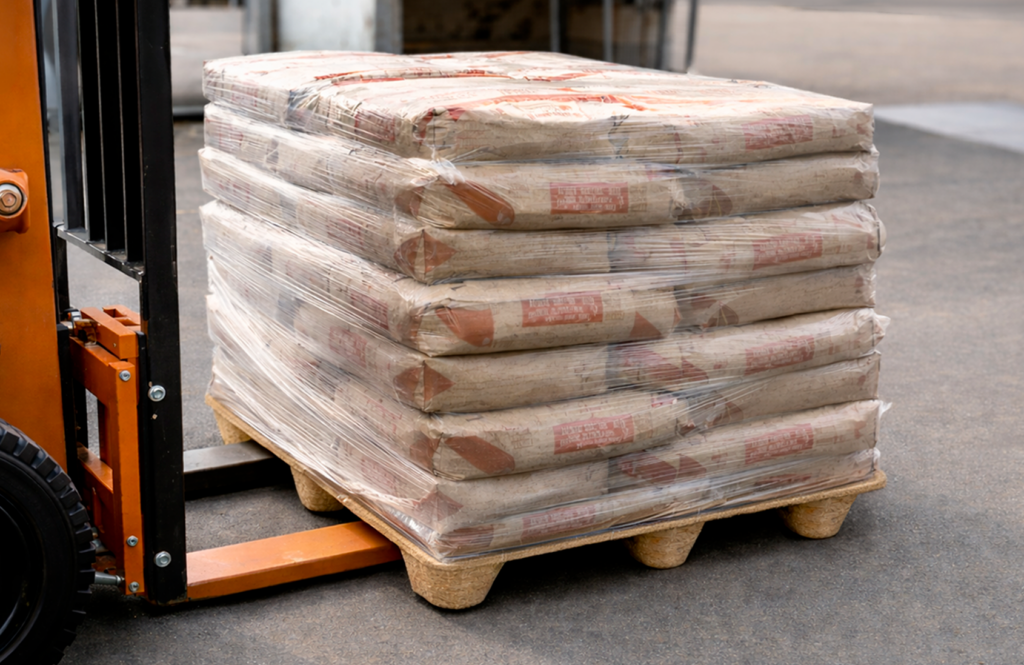
Pressed wood pallets withstand significantly higher impact forces than traditional pallets.
4. Moisture Control and Clean Performance That Keep You Compliant
Traditional wooden pallets have one fatal flaw: they breathe. They absorb moisture, swell, shrink, and harbor contaminants, weakening their structure and compromising hygiene. That’s unacceptable in industries where cleanliness and compliance are non-negotiable.
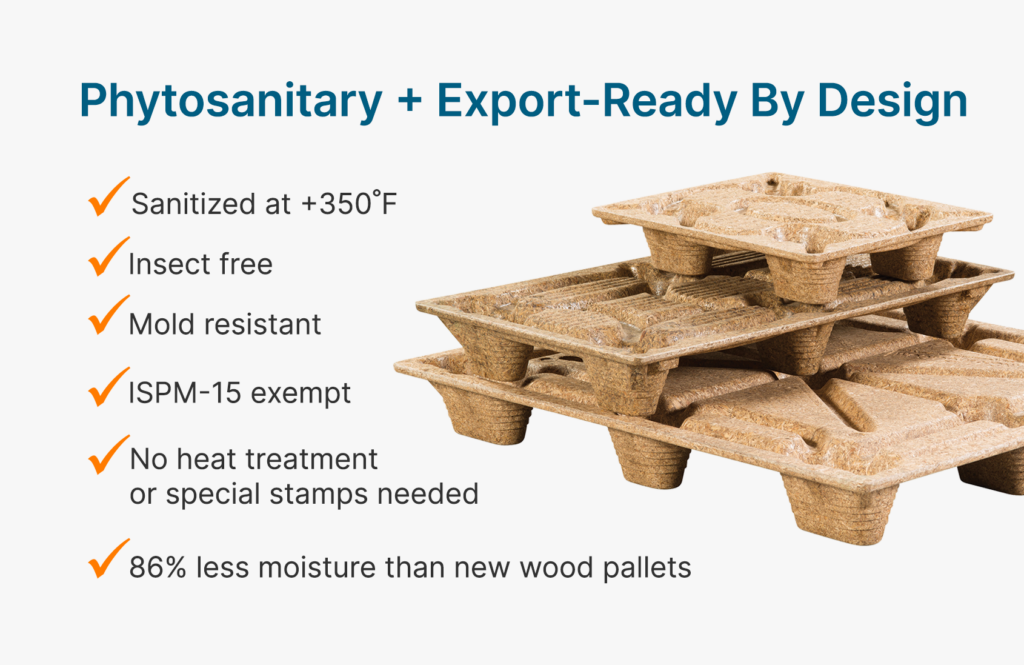
Pressed wood pallets are different. Molded at over 350°F, they are naturally sealed and contain up to 86 percent less moisture than new GMA wood pallets, and 30 percent less than repaired ones.
This ultra-dry design means:
- No warping or swelling from humidity changes;
- No rot, mold, insect, or bacteria risk – ideal for food, beverage, and pharmaceutical industries;
- Naturally ISPM-15 exempt; and
- Cleaner, safer transport for sensitive goods and packaging.
The USDA’s Animal and Plant Health Inspection Service confirms that wood packaging used in international trade must be treated or marked in accordance with ISPM-15, unless it qualifies as “processed wood.” Because pressed wood pallets are heat-processed above 350°F, they fall under that exemption, giving them a significant export advantage.
5. Smarter Design That Saves Space, Time, and Money
The science behind pressed wood pallets goes beyond material strength – it’s about total system efficiency and supply chain resilience. From warehouse storage to last-mile delivery, every design element has been optimized for performance and profitability.
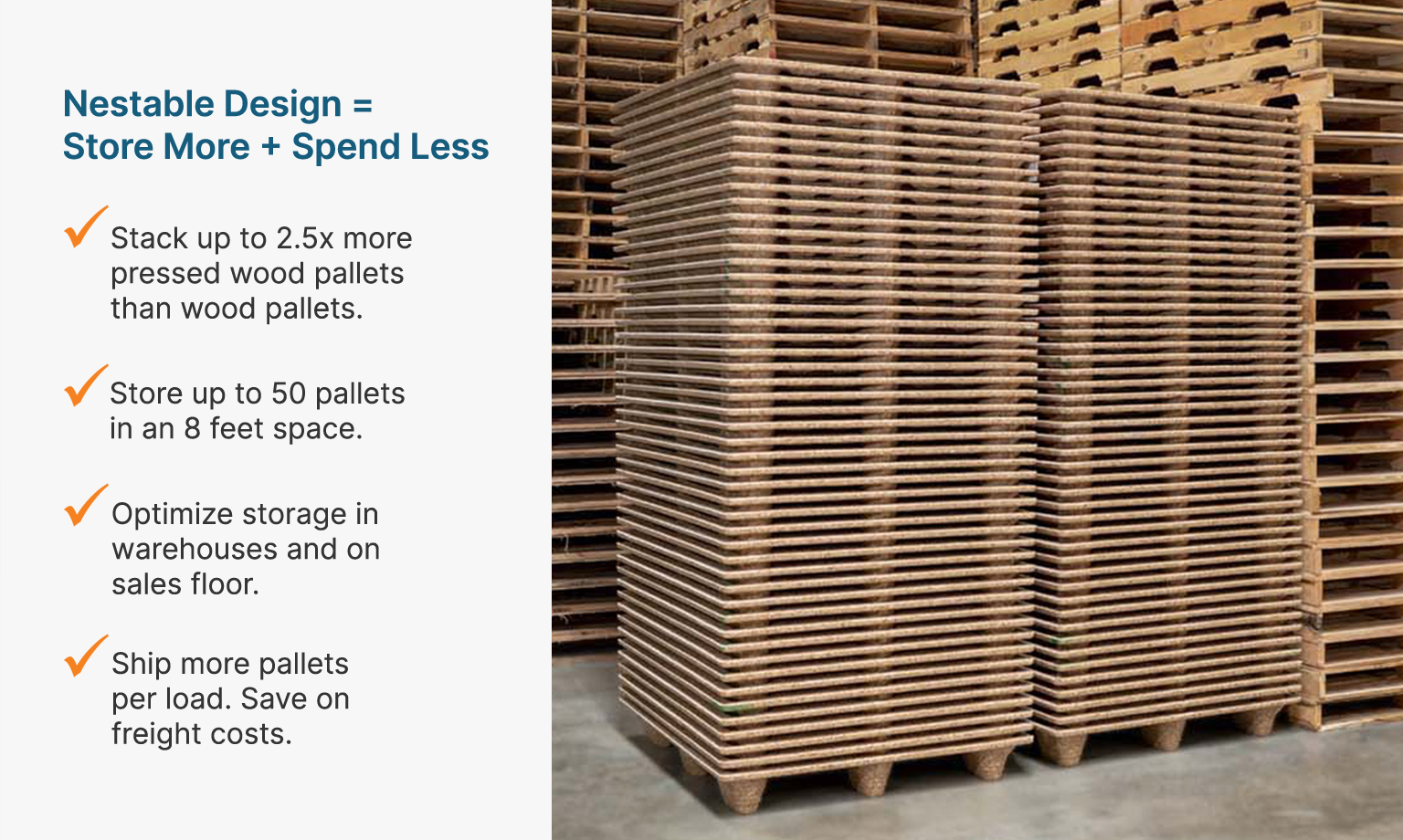
a. Nestable design for superior storage efficiency
Pressed wood pallets nest neatly inside one another, allowing up to 2.5× more pallets per stack than standard block pallets. That means freed-up floor space, lower storage costs, and cheaper empty backhauls – big wins for lean logistics.
b. True four-way forklift access
Full four-way entry makes handling faster, safer, and more flexible. Operators can approach from any direction, improving flow and minimizing aisle congestion.
c. Perfectly flat, uniform deck
Automation loves consistency. Because every pressed wood pallet is molded identically, the deck is perfectly flat – ideal for shrink-wrapping, robotic palletizers, and high-speed conveyors. No gaps, no misalignment, no jammed rollers.
d. No nails, splinters, or exposed fasteners
Say goodbye to popped nails, damaged packaging, and frequent worker injuries. Pressed wood pallets contain zero fasteners. Their smooth molded surfaces protect packaging, equipment, and people – no maintenance required.
e. Proven lifecycle value
Durability pays dividends. When you factor in longer life, lower product damage, and reduced storage costs, the total cost of ownership for pressed wood pallets outshines repaired wooden pallets.
Litco’s testing data, combined with independent research from the CPULD and standardized test frameworks such as ASTM D1185, support the claim of a longer life cycle and fewer replacements under real-world conditions.
Sustainability Meets Strength
Every pressed wood pallet begins with reclaimed wood fibers – by-products that might otherwise end up as waste. Through heat, pressure, and innovation, they’re reborn into a strong, reusable product that supports a circular economy.
When the pallet eventually reaches the end of its long service life, it can be reground and remolded into new pallets, closing the loop. It’s performance with purpose: eco-smart strength that supports your sustainability goals without sacrificing durability.
The result is a circular, resource-efficient solution that proves durable pallets can deliver both environmental responsibility and long-term operational value.
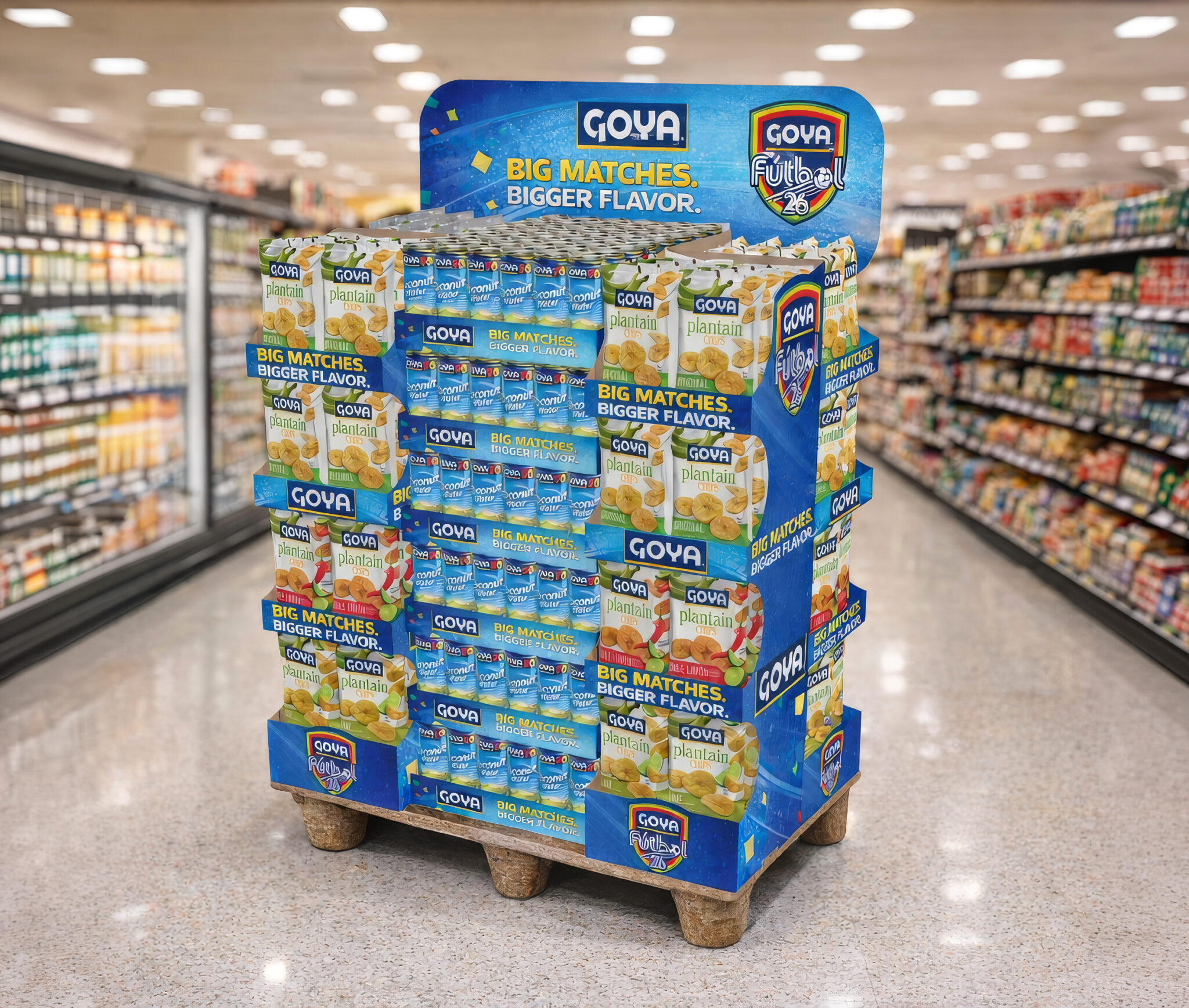
Smooth, uniform pallets are ideal for retail displays and point-of-purchase applications.
Perfect for POP and Retail Applications
In retail and display settings, presentation matters. Because pressed wood pallets are clean, uniform, and free of nails or splinters, they’re perfect for POP displays and point of purchase displays that must look professional and stable on the sales floor.
Their flat decks, consistent dimensions, and smooth molded finish make them ideal for direct-to-retail applications – no repalletizing required. It’s the same science and strength, now working for your brand’s presentation and efficiency.
Choose the Right Pallet – Choose Litco
Whether you manage a high-volume warehouse, an export operation, or retail logistics, the right pallet makes all the difference. It protects your product, streamlines your workflow, and safeguards your people. For organizations focused on reliability and long-term performance, durable pallets are an essential part of an efficient supply chain.
Litco’s pressed wood pallets provide all that – and more. Backed by data, built for durability, and linked to authoritative labs and compliance standards, they’re the smarter, safer, and more sustainable way to move your business forward.
Choose the right pallet. Choose science. Choose Litco.
Commonly Asked Questions
How much stronger are pressed wood pallets compared to GMA pallets?
Pressed wood pallets are up to 70% stronger than traditional stringer pallets, with static load capacities reaching 16,000–21,500 lbs compared to about 14,000 lbs for standard GMA pallets.
This added strength reduces the risk of pallet failure during stacking, storage, and transport. For companies evaluating durable pallets, it provides a critical safety margin—especially when handling heavy, high-value, or retail-ready shipments.
What makes pressed wood pallets more durable than conventional pallets?
Pressed wood pallets are more durable because they are molded as a single solid unit, eliminating weak points like nails, fasteners, and joints that commonly fail in traditional wood pallets.
This one-piece construction distributes weight and impact evenly, improving performance in pallet durability analysis. The result is fewer breakages, longer service life, and more consistent performance across demanding supply chain environments.
Why does pallet stiffness matter for product protection?
Pallet stiffness is critical because it reduces bending under load, helping prevent product damage during handling, storage, and transportation.
Pressed wood pallets provide up to six times greater stiffness than traditional wood pallets, minimizing movement and vibration. This is especially important for fragile goods, electronics, and POP displays where stability directly impacts product quality and presentation. To better understand how these factors influence your decision, it’s important to evaluate how to choose the right pallet for your operation.
Do pressed wood pallets last longer in real-world conditions?
Pressed wood pallets are designed to last longer in real-world conditions due to their high-density molded structure and resistance to impact, moisture, and structural fatigue.
Unlike traditional pallets, they don’t loosen over time because they contain no fasteners or joints. This results in fewer replacements, reduced downtime, and better long-term performance for businesses that rely on durable pallets.
Are pressed wood pallets better for export and compliance?
Pressed wood pallets are ISPM-15 exempt because they are heat-processed above 350°F, qualifying them as compliant processed wood for international shipping.
This eliminates the need for additional treatments or certifications, simplifying export logistics. For global supply chains, choosing the right pallet can significantly reduce delays, costs, and compliance risks.
Do pressed wood pallets resist moisture and contamination?
Pressed wood pallets contain up to 86% less moisture than traditional wood pallets, making them highly resistant to mold, bacteria, and environmental contamination.
This low-moisture design prevents warping and swelling while improving hygiene. As a result, they are widely used in food, beverage, and pharmaceutical industries where clean, compliant pallet solutions are required.
How do pressed wood pallets improve warehouse efficiency?
Pressed wood pallets improve warehouse efficiency through nestable design, uniform dimensions, and true four-way forklift access.
They allow up to 2.5× more pallets to be stored in the same space while improving handling speed and automation performance. This makes them an ideal choice when companies need to choose the right pallet for optimized storage and workflow efficiency.
Are pressed wood pallets more cost-effective over time?
Pressed wood pallets are more cost-effective over time because they reduce product damage, require fewer replacements, and lower storage and transportation costs.
Their durability and nestable design contribute to lower total cost of ownership. For businesses focused on long-term value, they represent one of the most efficient durable pallet solutions available.
What industries benefit most from durable pressed wood pallets?
Pressed wood pallets are ideal for industries such as food and beverage, retail, pharmaceuticals, and export logistics where durability, cleanliness, and consistency are essential.
Their smooth, uniform design makes them especially effective for POP displays and retail applications, where both product protection and presentation quality are critical.