ARTICLE
How the Right Pallet Can Improve Warehouse Storage Efficiency While Maximizing Transit Space
How the Right Pallet Can Improve Warehouse Storage Efficiency While Maximizing Transit Space
Table of Contents
“Your goal is straightforward: move as much product as possible—without damaging shipments or slowing down workflows.”
“Pressed wood pallets, by contrast, are uniformly molded and fully nestable—allowing you to safely stack up to 50 units within an 8-foot vertical space.”
Read a Case Study
Discover how Wonderful® Pistachios, America’s top-selling snack nut, solved a major supply chain challenge by switching from unreliable recycled wooden stringer pallets to Litco’s sustainable pressed wood pallets.
“The pallet you choose plays a critical role in warehouse space efficiency and supply chain performance”
June 24, 2026
9 Minute Read
Most people see pallets as basic commodities – just platforms that move goods from Point A to Point B. But anyone working in warehousing or distribution knows better: pallets are critical components in the supply chain.
Yet despite their importance, pallets are rarely evaluated for their impact on warehouse storage efficiency – a key driver of operational throughput. That oversight becomes costly as production increases and space tightens, because the right pallet can recover valuable storage capacity and improve handling.
This article explains how pressed wood pallets – particularly Litco’s Inca Engineered Molded Wood™ pallets – help companies improve warehouse space efficiency and maximize transit capacity.
Why Warehouse Space Efficiency Matters
Every inch of supply chain space is valuable. Production, transportation, and warehousing all operate with limited square footage. Multiply that constraint across months of output and hundreds of truckloads, and the pallet you choose can unlock substantial savings.
Your goal is straightforward: move as much product as possible – without damaging shipments or slowing down workflows. Efficient pallet storage supports that goal by freeing manufacturing and warehouse space, giving teams more room to stage, pick, pack, and ship. Inefficient storage, however, creates avoidable problems, including:
- Wasted space
- Lower capacity utilization
- Reduced throughput
- Higher handling and operational costs
Litco’s Inca Engineered Molded Wood™ pallets directly address these challenges. Their uniform, nestable design helps you optimize space, improve handling efficiency, and streamline distribution.
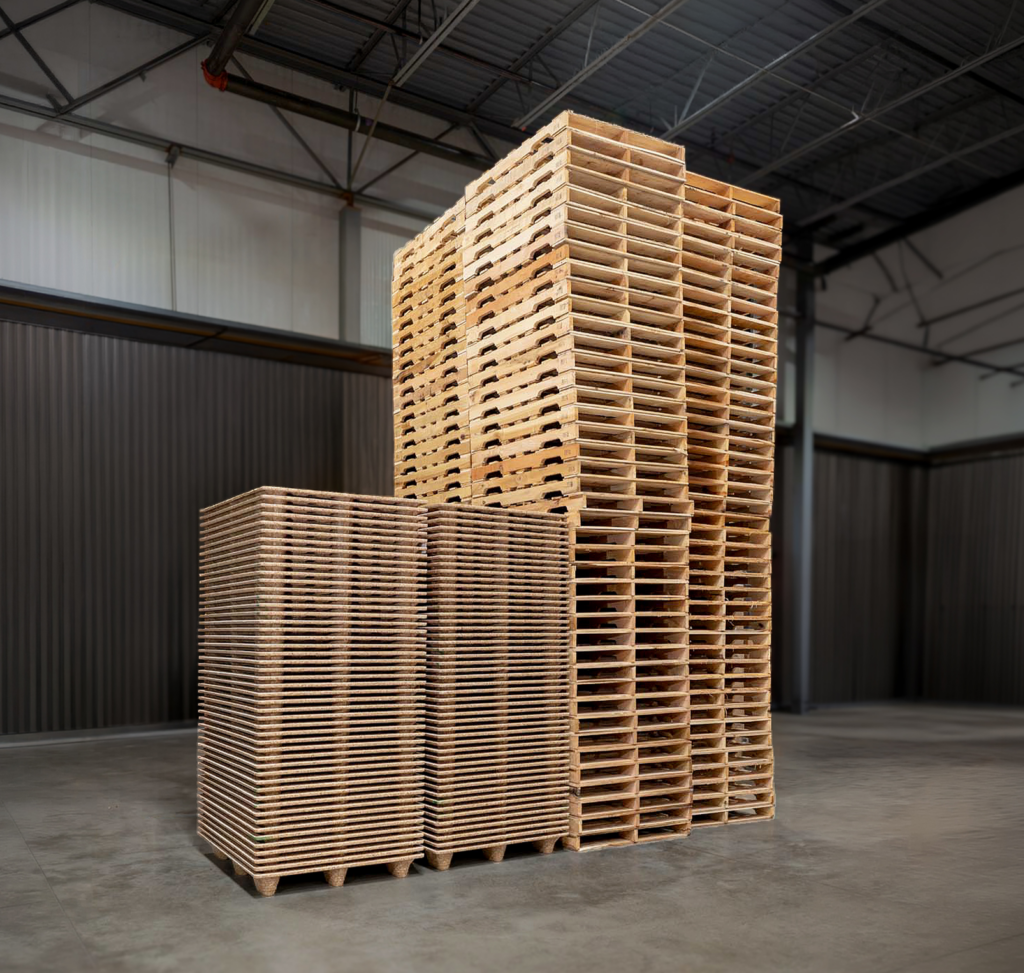
Uniform, nestable pressed wood pallets can dramatically increase pallet storage capacity compared to traditional stringer pallets, helping operations make better use of available warehouse space.
3 Ways Pressed Wood Pallets Improve Efficiency
1. In Transit
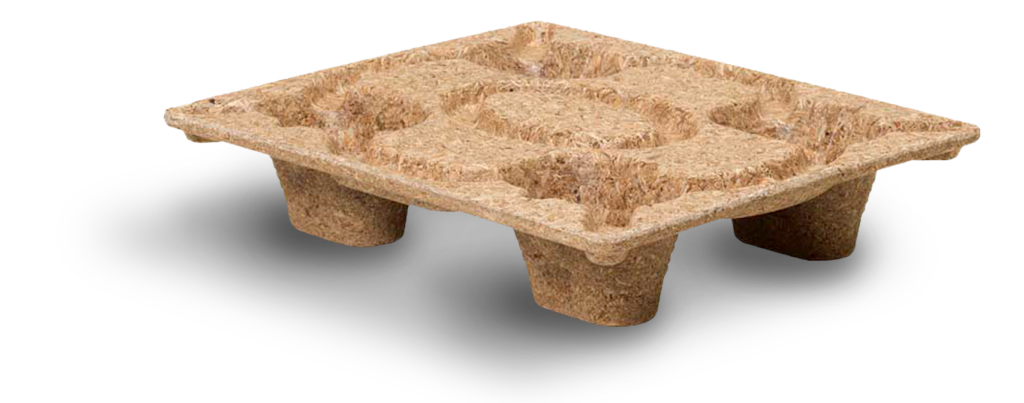
Some of the biggest gains from a pressed wood pallet occur before it ever enters your facility. Litco’s Inca-brand Engineered Molded Wood™ pallets are 100% uniform in size and shape, and their nestability allows pallets to stack tightly during transport.
Traditional GMA-style pallets can vary in board thickness, nail placement, and overall build quality. These inconsistencies can slow handling, complicate stacking, and reduce transit-space efficiency. Pressed wood pallets eliminate these issues entirely.
Each pressed wood pallet is molded to exact, repeatable specifications, producing a precision-made, uniform pallet every time. This consistency is paired with a fully nestable design – much like 5-gallon buckets that fit neatly inside one another – which delivers major space advantages on every truckload.
With pressed wood pallets, companies can ship up to 4,200 quarter pallets (in a 53′ x 8′ truckload), compared to roughly 1,000 wood quarter pallets. That’s a 4:1 space-saving gain that directly lowers freight costs. The same applies to standard 48×40 pallets, which average 1,200 pressed wood pallets per truck, compared with 420 wooden pallets. Across a full year, these gains translate into:
- Reduced freight costs
- Fewer trucks on the road
- Lower fuel consumption
- Less CO₂ emitted per inbound shipment
In short, choosing Litco’s pressed wood pallet creates measurable supply chain efficiencies – long before the pallets ever reach your warehouse.
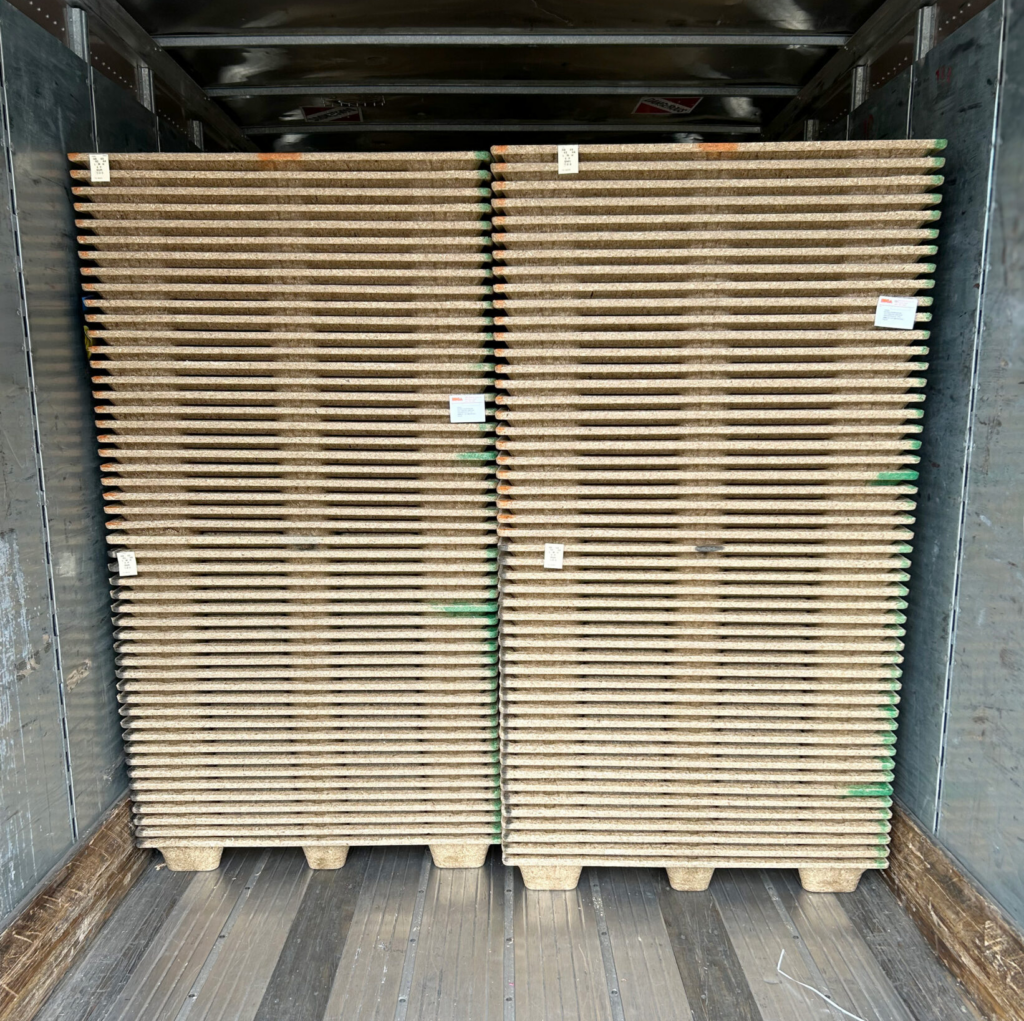
By maximizing the number of pallets shipped per truckload, pressed wood pallets help reduce transportation costs while improving overall supply chain efficiency.
2. In Your Warehouse
For companies evaluating ways to improve warehouse storage efficiency, pressed wood pallets offer one of the simplest, most immediate solutions available.
Litco’s Inca Engineered Molded Wood™ pallets are designed specifically to maximize warehouse space efficiency, helping you store more inventory without expanding your footprint.
Higher Vertical Stackability
Traditional wood and plastic pallets can only be stacked so high before stability becomes a problem. Pressed wood pallets, by contrast, are uniformly molded and fully nestable – allowing you to safely stack up to 50 units within an 8-foot vertical space. The result: significantly more pallet storage using far less floor space.
Improved Maneuverability, Handling, and Product Protection
Pressed-wood pallets offer true four-way access, allowing workers to access them from any direction with forklifts or pallet jacks. This versatility reduces loading time and makes material handling faster and more efficient – especially in tight aisles or congested staging areas.
Litco’s pressed wood pallets are also up to eight times stiffer than traditional GMA-style pallets. Greater stiffness means less flex under heavy loads and fewer vibrations during transit, resulting in more stable unit loads and better protection for the products being shipped.
Optimized Space Utilization
Warehouse space utilization reflects how effectively a facility uses its available space. Industry resources show that most warehouses operate best at 70–80% utilization, avoiding both wasted space and congestion. Litco’s pressed wood pallets help maintain this sweet spot by increasing stacking density, improving vertical storage, and enabling smoother material flow.
Reduced Workforce Stress and Physical Strain
Pressed wood pallets eliminate issues like warped stringers, nail pops, and splinters, creating safer, smoother handling with fewer workflow disruptions. And because they are up to 33% lighter than wood pallets, they also reduce manual strain and provide stable, dependable load performance.
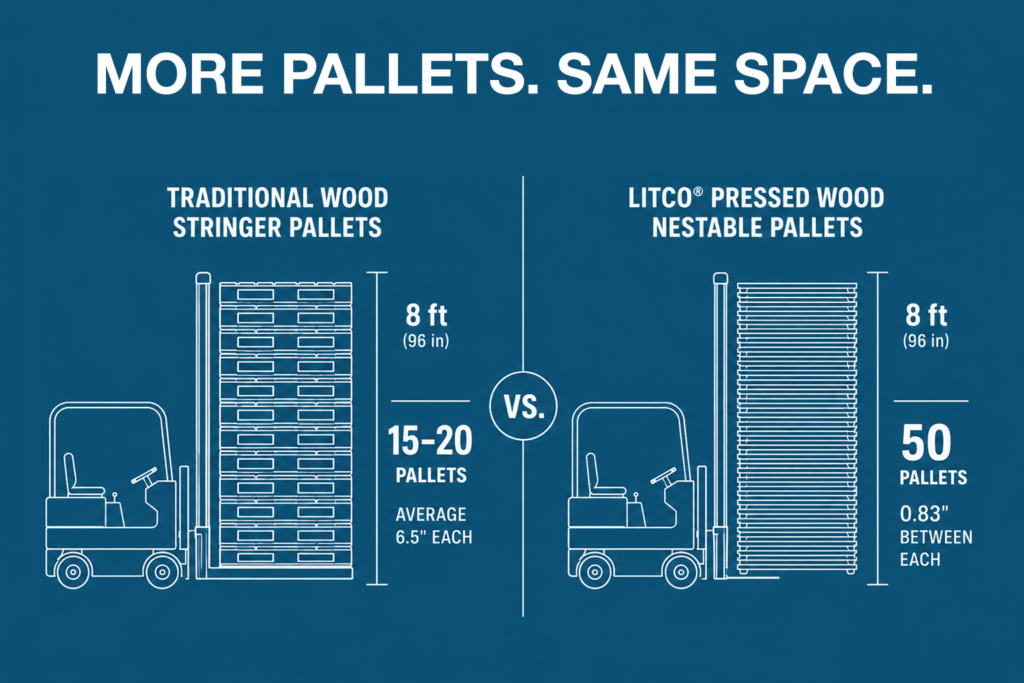
Warehouse space is expensive. Litco’s nestable pressed wood pallets let you store more than three times as many pallets in the same vertical space.
3. In Retail
The same space efficiencies you gain in the warehouse extend directly to retail. When POP displays arrive pre-assembled on pressed wood pallets, retailers benefit from instant setup, less backroom storage, and reduced floor clutter. And because pressed wood pallets are nail-free and lighter than traditional wood pallets, store teams can reposition displays with less strain and lower injury risk. With no nails, retail floors are also protected from scratches, gouges, and scuffs – preserving both the store environment and the customer experience.
Reduce Supply Chain and Warehouse Disruptions
These combined transit, warehouse, and retail advantages reinforce a core Litco commitment: reducing supply chain and warehouse disruptions. Our pressed wood pallets are molded to precise specifications to ensure uniform shape, size, and performance.
Because every pallet arrives identical and ready to perform, your teams – and your customers – experience fewer handling delays, fewer staging bottlenecks, and fewer workflow disruptions. As companies work to optimize capacity utilization throughout 2026, this level of reliability becomes essential for improving warehouse storage efficiency.
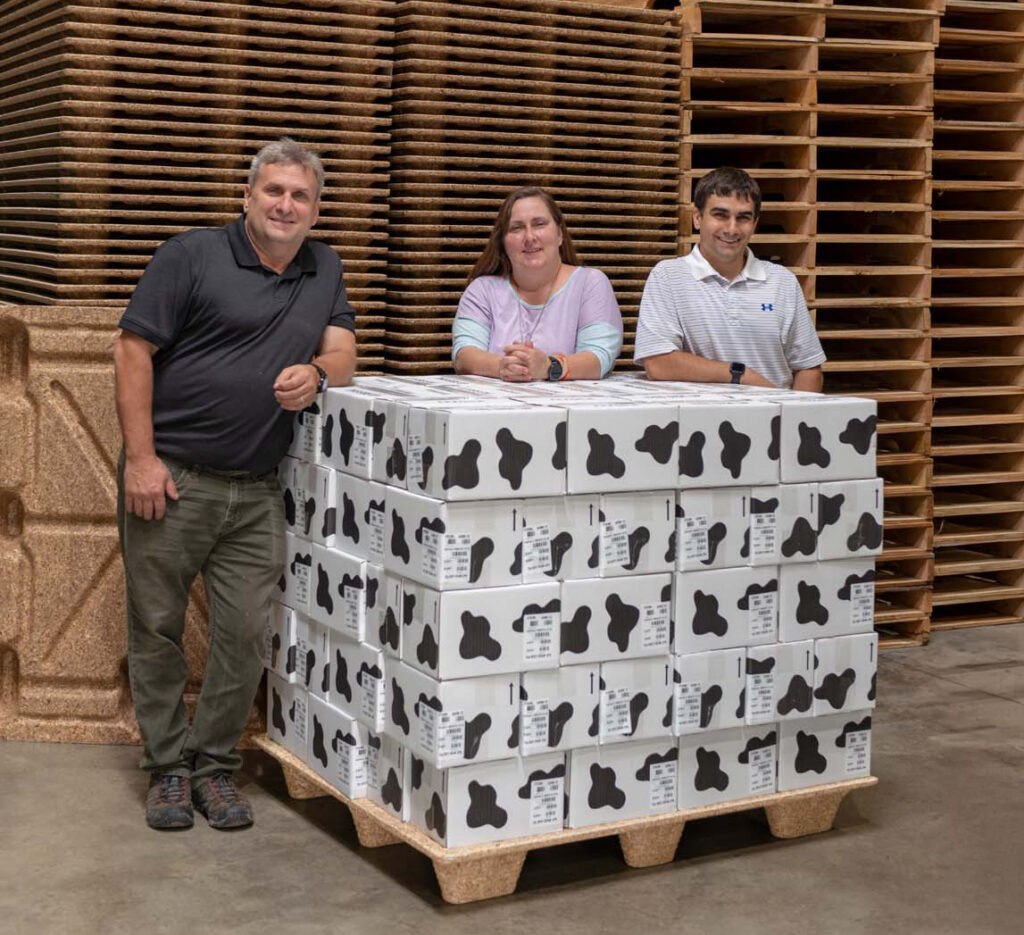
Pressed wood pallets help POP display manufacturers and brand owners maximize warehouse space, improve transit efficiency, and deliver retail-ready displays with fewer supply chain disruptions.
The Smarter Pallet Choice for Stronger Performance – Your Next Step Forward
The combined efficiencies and reliability of pressed wood pallets point to a clear conclusion: the pallet you choose plays a critical role in warehouse space efficiency and supply chain performance.
Litco’s Inca-brand Engineered Molded Wood™ pallets reduce wasted space, improve maneuverability, and deliver uniform, repeatable performance. And because Litco is the only North American producer of molded pressed wood pallets, you gain the reliable supply and steady availability that modern distribution networks depend on.
We offer multiple pallet sizes and load capacities to meet a wide range of applications. Explore detailed specifications, or contact us anytime – our team is ready to help you select the ideal pallet solution to support your operation.
Choose the Right Pallet. Choose Litco.
The pallet you choose affects much more than moving products from one place to another. It impacts product protection, freight costs, warehouse efficiency, export compliance, sustainability, and even worker safety.
Litco’s Engineered Molded Wood™ pallets are built to perform at every stage of your supply chain. Backed by independent testing from Virginia Tech and certified Cradle to Cradle® and USDA BioPreferred®, they’re a proven choice for companies seeking greater efficiency and reliability.
Discover why companies across North America choose Litco.
Commonly Asked Questions
How do pressed wood pallets improve warehouse storage efficiency?
Pressed wood pallets improve warehouse storage efficiency by maximizing stacking density, reducing floor-space requirements, and improving material flow throughout the facility.
Because Litco’s Inca Engineered Molded Wood™ pallets are fully nestable and uniformly molded, they can be stacked more efficiently than traditional wood pallets. Their design helps companies store more pallets in less space, improve warehouse organization, and support better utilization of valuable storage capacity without expanding their footprint.
Can pressed wood pallets reduce transportation and freight costs?
Yes. Pressed wood pallets help reduce transportation costs by allowing significantly more pallets to fit on a truckload compared to traditional wood pallets.
Their nestable design enables tighter stacking during shipment, creating major space savings in transit. The article notes that companies can ship up to 4,200 quarter pallets per truckload compared to roughly 1,000 traditional wood quarter pallets. These efficiencies can lead to fewer truckloads, lower freight expenses, reduced fuel consumption, and lower CO₂ emissions.
Why are nestable pallets beneficial for warehouse operations?
Nestable pallets help warehouses save space, improve organization, and increase operational efficiency.
Unlike conventional pallets that stack one on top of another, nestable pressed wood pallets fit inside each other when empty. This allows companies to store substantially more pallets in the same area, reduce clutter in staging zones, and free valuable floor space for inventory, production, and shipping activities.
How do pressed wood pallets help reduce supply chain disruptions?
Pressed wood pallets help reduce supply chain disruptions by providing consistent, repeatable performance throughout transit, warehousing, and retail environments.
Every pallet is molded to precise specifications, ensuring uniform size, shape, and functionality. This consistency helps reduce handling delays, staging bottlenecks, and workflow interruptions while supporting smoother movement of products through the supply chain.